The increase in players choosing to represent their country of heritage rather than their country of birth at this year’s World Cup raises new questions about who gains and who loses. When a footballer born, raised and trained in France chooses to play for Algeria, Senegal or Morocco, has Europe "lost" its investment?
Too often, the answer is reduced to a simplistic equation: one country pays for the player’s development while another freeloads off it. But football does not work like a conventional "brain drain" story.
Take Brahim Diaz, for example. Born in Malaga, he plays club football for Real Madrid but has chosen to represent Morocco’s Atlas Lions. Despite playing for a different national team, he still plays for a European club, generating transfer value for its owners, paying taxes in Europe, and appearing weekly in European competitions. What shifts is not his economic value but his representative role: the flag under which he competes, the anthem he sings, and the national story he helps tell.
A new era of football
As we have seen in this World Cup, with almost a quarter of the tournament’s players born outside the country they represent, these transnational dynamics are now part of the operating system of modern football.
At club level, Brazil, France and Argentina are the leading exporters of footballers across 135 leagues, with France alone accounting for 2,293 distinct expatriate footballers between 2020 and 2025. FIFA’s transfer data shows the same point from the market side. In 2024, it recorded 78,742 international player transfers across men’s and women’s professional and amateur football. Men’s professional spending reached USD 8.59 billion – the second-highest figure ever recorded.
“Lost investment” is the wrong framing
Critics complain that Europe trains the player, then the ancestral homeland reaps the rewards. But value in football is far from linear. As well as retaining the player’s contract, weekly labour, and the transfer asset, European clubs may also benefit through increased visibility and a higher valuation if the player performs well in high-profile international tournaments watched by scouts, agents, and journalists.
Using public market-value estimates and reported fees as indicative signals rather than exact, audited prices, the figure below demonstrates the increase in market value of diaspora players after they opted to play for their country of heritage. It deliberately mixes one very clean tournament re-rating case, Sofyan Amrabat, with longer-run cases such as Kadıoğlu, Balogun, Lookman and Wilson Isidor. The point is not that national-team choice alone causes the increase in price, but that representative exposure can feed the club market by changing a player’s visibility, narrative and perceived ceiling.
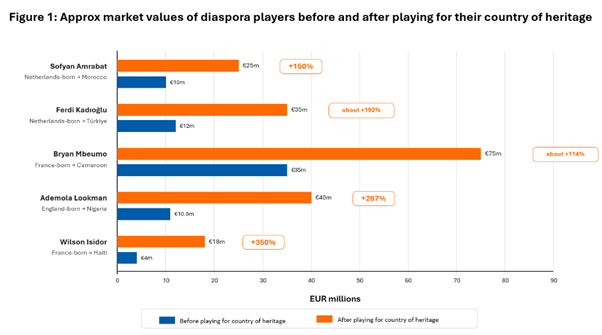
Sources: transfermarket.com; footballtransfers.com; Doha News; ESPN.com; the Guardian
It’s worth noting that not every national-team switch produces a price increase. However, the national-team shirt can help convert representative value into market attention. A player may represent Türkiye, Cameroon or Haiti, while their re-rating is still monetised through Fiorentina, Villarreal or Sunderland.
What the European country may, however, lose when a player chooses to represent another country is arguably harder to measure. It loses the opportunity to strengthen its national team, to see the player draped in its flag, and to claim, "This star is ours." In return, the ancestral homeland gains sporting talent, international prestige and diasporic pride. Value, therefore, circulates between national story and club economy rather than moving permanently from one country to another.
Football complicating the legacies of colonialism
The politics surrounding diaspora representation in football become complex when viewed through the lens of migration history. European national teams and clubs have long benefited from the sporting consequences of migration, with countries such as England and France becoming major producers of African-heritage through empire, labour migration, postcolonial citizenship, family reunification, urban settlement and racialised working-class football cultures.
However, when players of African heritage choose to represent African national teams, these descendants of migration may strengthen ancestral homelands rather than European national projects.
This is not a straightforward ‘decolonisation’ of football. But diaspora representation interrupts Europe’s symbolic monopoly over postcolonial talent. It says that the footballer’s body may have been trained in Europe while their national imagination points elsewhere.
This tug-of-war is now institutionalised. FIFA’s eligibility rules and Change of Association Platform make sporting nationality visible as a field of governance, enabling federations to scout diasporas earlier, track youth systems, build relationships with families, and offer not only opportunities to play but also recognition, trust and belonging.
Diaspora as infrastructure
It would be a mistake, however, to treat diaspora connection as sentiment alone. Diaspora is also infrastructure: families who maintain ties across borders, community clubs, scouts, agents, federation databases, and national narratives that make a player's choice meaningful. The prominence of diaspora-born players in Morocco’s World Cup squad shows how powerful this infrastructure can become when it is effectively organised.
A large diaspora in France, Belgium, the Netherlands, England, or Spain can become a football resource because those countries contain dense academy systems and professional pathways. But the advantage is unequal. Not every diaspora is located inside elite football infrastructure, and not every federation has the capacity to identify, persuade, and integrate players abroad.
Reframing the debate
A footballer can carry different forms of value simultaneously: economic value for clubs, representative value for national teams, emotional value for families, and political value for diaspora communities.
In an increasingly transnational world, the academy and the anthem no longer need to belong to the same place. Europe may train the player. Africa may present them on the international stage. But the footballer is not wholly the property of either. Diaspora football exposes the tension between those realities.
Note on the data
This piece uses birthplace as the main indicator of diaspora representation because it is visible and comparable. That excludes second-generation players born in the country they represent and players whose football formation differs from birthplace.
Market values are estimates and signals, not audited prices. The case studies mix public market valuations and reported fees because these are the available public proxies for club value. Where the “before” benchmark is not the exact date of a national-team switch, it is labelled as a benchmark around the relevant exposure period rather than a strict causal measure.
Further reading from the COMPAS Blog
Pride of Place: The story behind Morocco’s World Cup squad by Myriam Cherti
Has migration become an ingredient of World Cup success? by Ben Brindle and Adam Sawyer
Morocco’s World Cup: The diaspora choose to champion their motherland by Myriam Cherti