Morocco has just named its squad for the 2026 World Cup finals. Over coffee or couscous across the land, debate rages over who made the cut and who didn’t. One thing, though, is certain: this group of 26 Atlas Lions now have the chance to turn the nation’s unprecedented success in Qatar into something more durable. As Africa’s top team, the squad enters the tournament eighth in FIFA’s world rankings, ahead of the likes of Germany, Italy and Belgium.
But the squad list is more than a selection of sportsmen. It tells an intergenerational story of transnational mobility: parents who left Morocco for work; children who grew up in European suburbs and trained at academies in Madrid, Amsterdam, Brussels and Lille; the emotional pull of family history; and a country that has learned to treat its diaspora not as an afterthought, but as a crucial part of its national football system.
The team’s 2022 World Cup run attracted global attention, but this story did not begin in Qatar. Morocco was the first team to qualify for the World Cup through a dedicated African campaign in 1970; the first African or Arab team to reach the knockout stages in 1986; and, in 2022, the first African or Arab team to reach a World Cup semi-final. Each milestone was celebrated as a national achievement. Yet the most recent of these breakthroughs also revealed a more contemporary reality: a nation that now plays football through athletes, memories and skills formed across multiple homelands.
The diaspora factor is more than a footnote
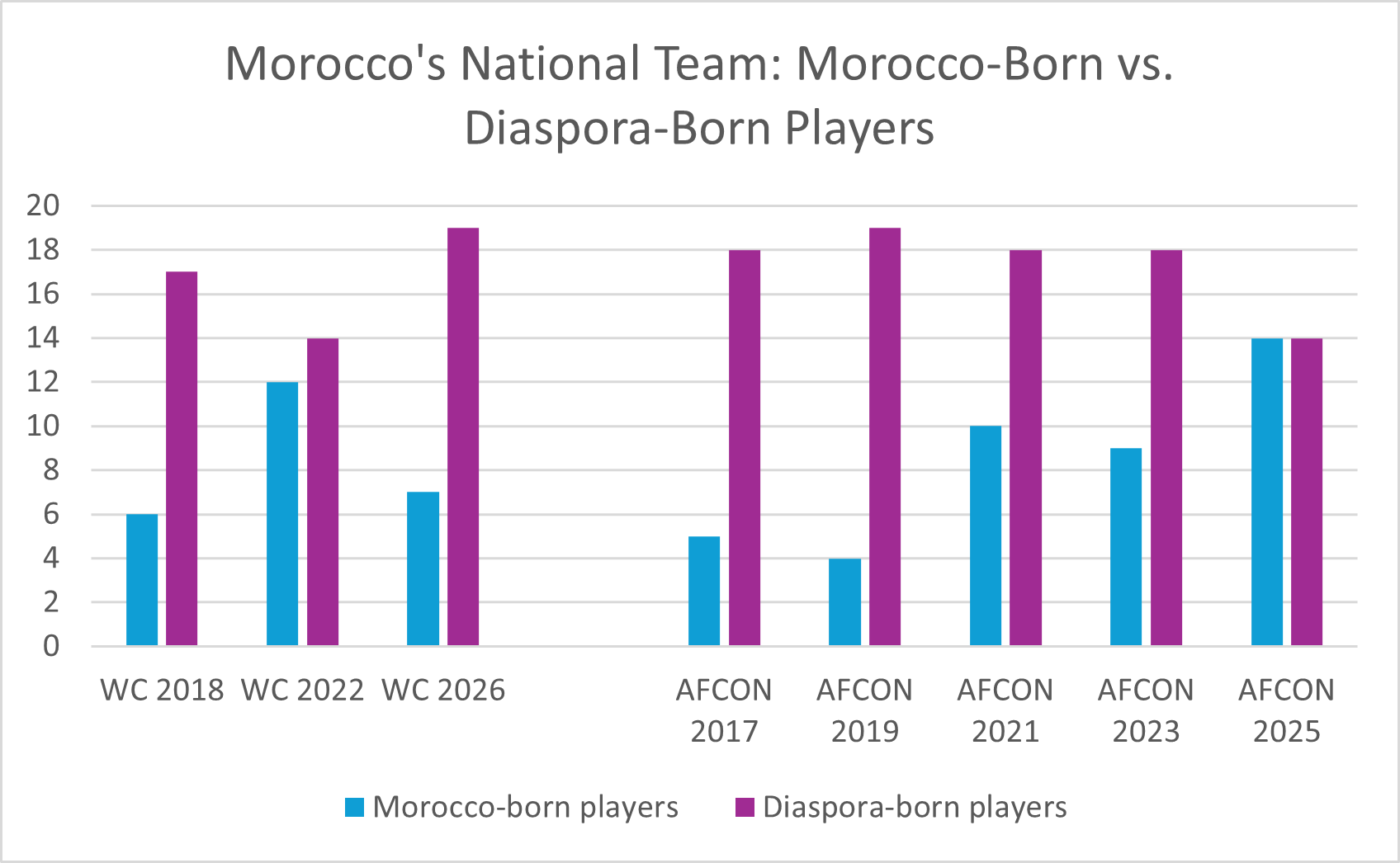
Members of Morocco's diaspora feature prominently in its 2026 World Cup squad (see Figure 1). Of the 26 players named, 19 were born outside Morocco. Of the 26 players in the country’s World Cup squad four years ago, 14 were born outside Morocco. For the African Cup of Nations (AFCON) 2025, the 28-man squad was split 50/50, with 14 Moroccan-born players and 14 born abroad. The graph below shows the numbers of Moroccan-born and diaspora-born players across recent AFCON and World Cup squads. The latest squad announcement suggests that the balance has shifted again. Morocco is not moving away from diaspora talent; instead, it is pursuing a more integrated setup, scouting gifted young Moroccans abroad while investing heavily in domestic football infrastructure.
Figure 1: Moroccan-born versus diaspora-born players across recent AFCON and World Cup squads
Source: author’s own analysis
Tapping into the diaspora is not unique to Morocco. One of the defining features of AFCON 2025 was the significant number of foreign-born players (especially European-born) representing African sides. Nearly 30% of players in that tournament were born outside Africa, with France as the leading overseas birthplace.
This diaspora factor in football raises key issues around ‘sporting citizenship’. Players with dual nationality or migrant backgrounds often have more than one pathway to play for a national team. Their decisions are shaped by personal identity, but also by professional opportunity, the likelihood of selection, the visibility of major tournaments, media pressure, family expectations and the strategies of national football federations. For these players, questions of ‘strategic belonging’ can emerge, where identity is negotiated across professional, emotional and political considerations.
This is why the phrase 'diaspora recruitment' can feel inadequate. Morocco's footballing success has not been accidental, but rather the result of a deliberate strategy, combining domestic investment, diaspora outreach, emotional belonging and professional credibility. Rather than relying only on European-born players, Morocco invested in its domestic infrastructure and professional structures, most notably the Mohammed VI Football Academy and the wider federation system. At the same time, it scouted players of Moroccan heritage in European academies before they were fully absorbed into other national teams. The message was not just that ‘you are eligible to play for Morocco’ but that ‘you belong with us, and there is a serious football project to be part of here’.
Appealing to both heads and hearts
International football forces dual-nationality players into decisions that are professional, personal and political. A player may ask: "Where am I more likely to play? Which federation trusts me? Which tournament gives me visibility?" But they may also ask: "What did my parents sacrifice? Which anthem makes my siblings cry? Where am I allowed to feel whole?"
The case of Brahim Diaz shows how this logic continues to evolve. Born in Malaga, developed later through Manchester City, AC Milan and Real Madrid, and was capped once by Spain in 2021. ‘Ssi Brahim’ (a title of respect in Moroccan culture) became one of the most high-profile players to choose Morocco in the current cycle. His decision matters because it was not a case of an overlooked fringe player taking the only available route to the international stage. It was a player from one of the world's biggest clubs choosing to place Morocco at the centre of his international career. His own explanation, that he feels “100% Spanish” and “100% Moroccan”, is useful because it resists the idea that such choices must be read as a zero-sum rejection of one country in favour of another.
The inclusion of Ayyoub Bouaddi in Morocco’s squad for the upcoming World Cup in North America pushes the same narrative into the next generation. Bouaddi, born in France and developed at Lille, has represented France at youth levels and was considered one of the most talented young midfielders of his age. Recent media reports stated that Morocco had persuaded him to represent the Atlas Lions rather than continue with France. The case shows how Morocco is now competing for future stars before their senior international identity is fixed.
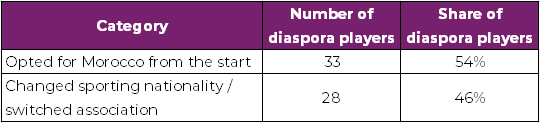
But is this always a fraught battle between national federations over who gets to keep talented individuals? Figure 2 below shows that, between 2017 and 2026, Morocco's foreign-born senior-player pool was almost evenly split between two routes. Out of 61 diaspora players assessed, 33 players (54%) appear to have opted for Morocco from the start, while 28 players (46%) changed sporting nationality or switched association after previously being involved with another national setup, usually at youth level. FIFA’s post-2021 eligibility framework has made some switches easier under defined conditions, especially for players with limited senior appearances before the age of 21.
Figure 2: Diaspora players' routes into the Moroccan senior squad between 2017 and 2026
Source: author's own analysis
Within these numbers, the pattern of countries of birth is also revealing. France is the largest source, contributing 27 of Morocco's diaspora players. It is followed by the Netherlands (12) and Belgium (11), although they show more of a ‘switching’ profile, with players tending to come through Dutch or Belgian youth pathways before later joining Morocco. In the 2026 World Cup squad alone, Morocco’s 19 foreign-born players break down into 11 who appear to have opted for Morocco from the start and 8 who had previously been involved with another national setup.
The data therefore complicates a simple story of late conversion: a slight majority of foreign-born players were already aligned with Morocco early in their international progress. Morocco is not simply 'importing' players but mobilising a transnational Moroccan football identity rooted in decades of migration history, family attachments and federation engagement.
This is where football complicates old debates about integration. A Moroccan-heritage player choosing to play for Morocco is not necessarily proof that integration in Europe has failed. Nor is it a simple rejection of Spain, France, Belgium or the Netherlands. It is better understood as layered belonging. Diaspora players can be socially formed in Europe, professionally trained in Europe, and still experience Morocco as a meaningful national home. Modern identity does not always move in single file. National teams are still powerful symbols of the nation, but the nation they represent is increasingly shaped by mobility, diaspora and migration history.
The other half of the story: domestic investment
A weaker version of the Moroccan approach would focus on scouring Europe for promising players and neglect the development of talent back home. It would suggest that the secret is simply to find better players abroad. However, Morocco's model works because diaspora engagement runs in parallel with serious investment in domestic infrastructure. The Mohammed VI Football Academy, investment in training centres, improved federation capacity, youth success and women's football development all matter because they lend the project credibility. As the president of the Royal Federation for Moroccan Football (FRMF), Fouzi Lekjaa, put it: “The development of football in Morocco should be based on a three-pronged approach, focusing on facilities, talent and well-qualified staff.” That matters because diaspora outreach is more persuasive when it is attached to a professional, ambitious and properly resourced national project.
Figure 1 is therefore not just a chart about birthplace. It is a graph about institutional balance. Morocco has moved between moments when diaspora-born players were heavily dominant and moments when the squad looked more mixed. The 2026 World Cup squad does not end that debate: it reopens it in a sharper form. With 19 foreign-born players and several high-profile omissions from the 2022 generation, it shows both the continuing importance of the diaspora and the emergence of a younger, more competitive pool. That matters politically as well as tactically. If attracting diaspora players is seen as replacing local pathways, resentment grows. If they are seen as complementing a competitive domestic nursery, they can enhance the national team without being perceived as displacing it.
This is why Morocco's 2026 World Cup squad should be read as the next phase of an evolving model. The question is no longer whether diaspora players count as Moroccan. That argument has largely been settled on the pitch and in the stands. The more interesting question is whether Morocco can sustain a football ecosystem in which European-born players, local academies and domestic clubs are all part of one pipeline.
What the squad tells us about the country
National squads are not neutral lists. They are, in part, public answers to some of society's private questions. Morocco's squad speaks of a country that has long experienced emigration, with major diaspora communities in France, Belgium, the Netherlands and Spain. But Morocco is also increasingly a country of immigration and settlement, especially for people from sub-Saharan Africa. Recent research in Casablanca describes Morocco as having shifted from being primarily a country of transit and emigration towards becoming a country of settlement, while reporting from the city describes migrants from Senegal, Mali, Congo, Niger and elsewhere not only passing through Morocco but also working, marrying, raising children and putting down roots.
That shift could further reshape Moroccan football in the next generation. The story of migration and the muntakhab maghrebi – the Moroccan national team – has so far focused on players of Moroccan heritage born in Europe. The next chapter may involve the children of sub-Saharan immigrants, born or raised in Morocco, trained in Moroccan schools and youth teams, and eligible to represent the country through residence or citizenship. If the Mohammed VI Football Academy and other pathways support youngsters in Morocco with a talent for football, regardless of their background, then a future Atlas Lions squad may include players whose family stories feature not only Casablanca, Fez, Paris or Brussels but also Dakar or Abidjan: a national team of natives, homecomers and newcomers alike.
Morocco's World Cup squad is more than a list of names. It is a snapshot of how migration has already changed the country, and a hint at how it may change again. The Atlas Lions' 2026 selection shows a national football project built across borders, domestic institutions, diaspora attachments, family memories and professional calculations – all carried with high hopes onto the same pitch.
Further reading from the COMPAS Blog:
Has migration become an ingredient of World Cup success? by Ben Brindle and Adam Sawyer
Morocco’s World Cup: The diaspora choose to champion their motherland by Myriam Cherti