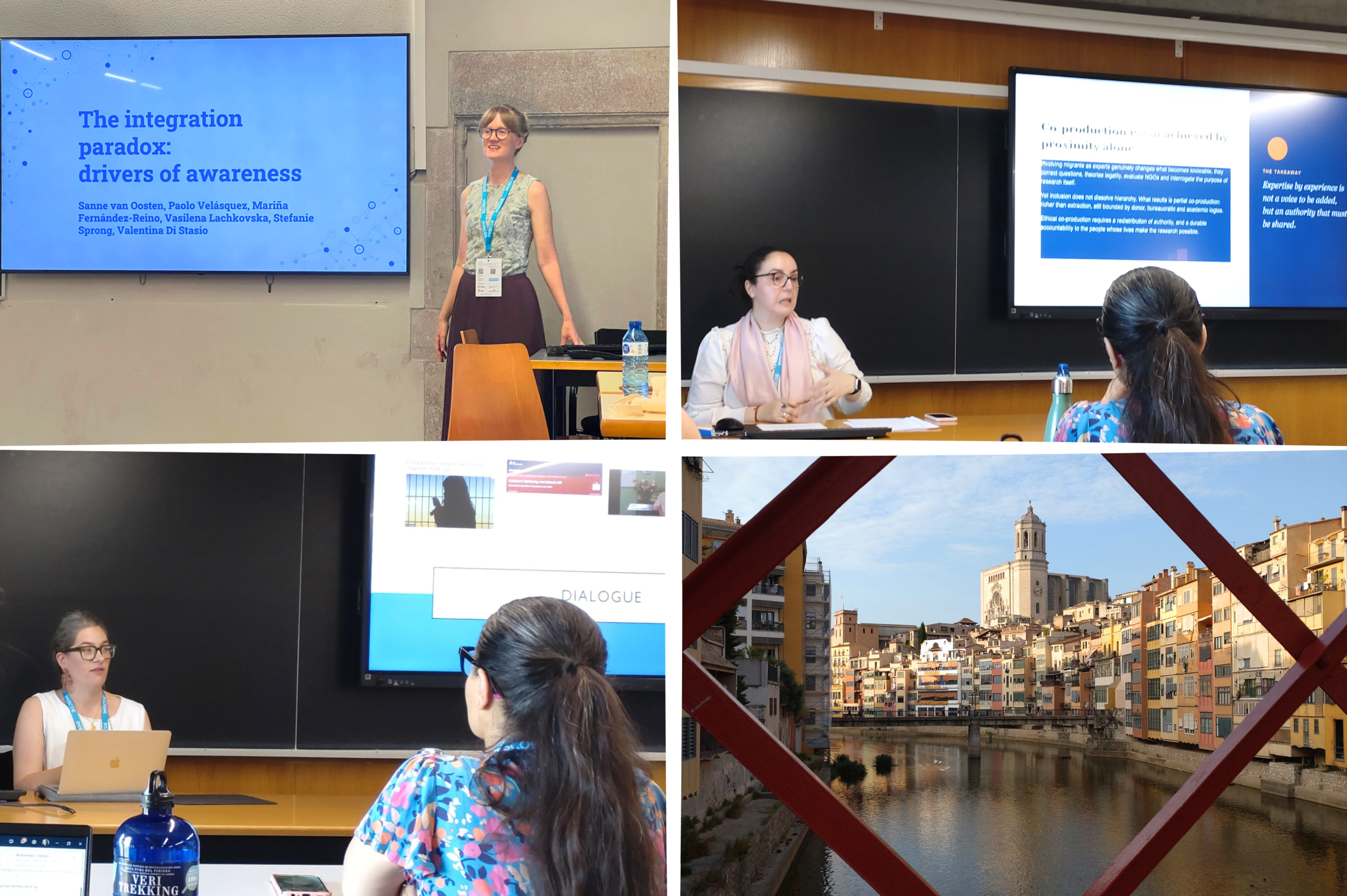
Members of the COMPAS team recently participated in the IMISCOE (International Migration Research Network) 2026 Conference in Girona. As well as presenting on topics relating to the conference theme, ‘Strengthening Migration Studies through Community Engagement’, the team also enjoyed collaborating with academic peers, civil society actors, artists, practitioners, and policymakers.
We spoke to those who presented at the conference to find out why their chosen topic matters, what they hope audiences took away from their presentations, and what they gained from attending.
Nuni Jorgensen, Researcher at the Migration Observatory based at COMPAS & José Ignacio Carrasco, COMPAS Research Affiliate
What was your presentation about?
The factors influencing differences in labour market inclusion between migrant women and men in Chile.
Why does this topic matter?
Migrant women often have lower participation rates (a measure indicating the percentage of the working-age population who are either employed or actively seeking work) and are more likely to work in insecure jobs than migrant men and native-born women. However, most of what we know comes from Europe and North America. Latin America has a different migration and labour market context, with widespread job precarity and a weaker link between regular migration status and formal employment. Examining what drives gender differences in the labour market in Chile can help us better understand gendered patterns of integration in South–South migration contexts.
What is the one thing you hope people will take away from your presentation?
Our study shows that understanding migrants’ labour market outcomes requires looking beyond the household in the destination country. Economic responsibilities towards family members abroad can have a significant influence on employment decisions, particularly for migrant women.
What was the most interesting discussion, question or moment from the event?
As this year's IMISCOE conference focused on community engagement, some of the most interesting discussions centred on participatory research: whether it is possible within current academic and funding structures, whether unequal or exploitative relationships can ever be fully overcome, and whether participatory research should always be the goal.
Jacqui Broadhead, Director of the Global Exchange on Migration based at COMPAS
What was your presentation about?
I chaired a panel that explored how to better include researchers with lived experience in policy-engaged research.
Why does this topic matter?
In line with the conference's theme, the panel offered an important opportunity to reflect on how we 'walk the walk' when we think about community engagement and how we ensure that the voices of those with lived experience are heard. It isn't enough simply to do this work; we have to commit to doing it authentically and in a way that moves beyond tokenism.
What is the one thing you hope people will take away from your presentation?
Two key things struck me in listening to the fantastic presentations. First, that this is ultimately about shifting power, even though research environments often remain profoundly unequal due to power imbalances. Second, this isn't only about researchers changing their practice; it also requires institutions to value this work and take it seriously.
What was the most interesting discussion, question or moment from the event?
One audience member asked how this work had changed the perspective of the presenters’ own research. I was struck by how profoundly each team had improved their research practices as a consequence of engaging with community researchers.
Sanne van Oosten, Senior Researcher at COMPAS (Research co-authored with Mariña Fernández-Reino, COMPAS Research Affiliate and Ely Stromberg, Researcher at the University of Amsterdam)
What was your presentation about?
Do same-sex and ethnic minority couples trying to secure a spot at a childcare facility in the UK face discrimination? Our research shows that they do not, but that Muslim fathers are discriminated against, whether they are in a same-sex or a different-sex couple.
Why does this topic matter?
Processes of discrimination are often intersectional. We expected to find that being part of a same-sex and ethnic minority couple would counteract discrimination, but we found no evidence to support this. Instead, we found that being both Muslim and a father resulted in the highest levels of discrimination from childcare facilitators.
What is the one thing you hope people will take away from your presentation?
That we need an intersectional lens – a framework used to analyse how different aspects of identity combine to create experiences of privilege and oppression – to understand discrimination.
What was the most interesting discussion, question or moment from the event?
It was a really good conference overall; I could not choose one moment 😊
Nathan Grassi, COMPAS Administrator
What was your presentation about?
I focused on the lived experience of migrant theatremakers living and working in the UK, highlighting both the positive and negative aspects of the arts industry. It was based on a panel discussion I convened in 2025.
Why does this topic matter?
The arts industry in the UK is already a precarious space for those who are a part of it. Facing barriers related to language, culture, and networks, many migrant artists still choose to come to the UK to start or further their education and training, broaden their creative practice, and advance their careers. Migrant theatremakers can offer new perspectives on migration research by working with researchers to translate research findings into accessible and engaging narratives.
What is the one thing you hope people will take away from your presentation?
I hope that people understand that story and experience are important parts of migration research. What is sometimes missing from research are the specific stories, the faces, and the individual humanity of migrants themselves, which help people find connection. Migrant stories are also multifaceted. While there's no doubt about the tragedy, oppression, and struggle (all of which still definitely need to be told), we need to open additional themes – hope, love, and, in many cases, joy and comedy.
What was the most interesting discussion, question or moment from the event?
This was my first academic conference; it was an entirely new and interesting experience and taught me a lot about my position and practice in both the arts and the university setting.