Professor Alan Gamlen is Director of the Migration Hub at the Australian National University. He completed his doctorate at COMPAS in 2009 and was Founding Editor in Chief of the journal Migration Studies, published by Oxford University Press. Emeritus Professor Peter McDonald is Australia's most celebrated demographer and has been a leading voice in Australian migration policy making for five decades.
Australia’s migration debate is stuck on the wrong number.
Like most high-income countries, Australia is experiencing what we call a ‘migration splash’ resulting from the COVID-19 pandemic. Migration and mobility flows ground to a halt during pandemic lockdowns, then rushed back with a vengeance to satisfy pent-up demand when borders re-opened. Public debate on immigration has been just as volatile, swinging from urgent calls for a catch-up surge of migration to spur post-lockdown economic recovery, to a moral panic about ‘mass immigration’ when that surge eventuated.
When politicians and commentators argue about migration, they usually focus on Net Overseas Migration (NOM): the single headline figure published each year by the Australian Bureau of Statistics. Net migration is just the sum of migrant arrivals and departures: arrivals minus departures equals NOM. The assumption is that if government can get NOM down, it can also get control of housing pressure, infrastructure strain, and public concern about migration.
That assumption is wrong. The real policy challenge is not aggregate migration in the abstract. It is the size and growth of Australia’s temporary migrant population (Figure 1).
Figure 1: Growth of the Temporary Population, 2009-10 to 2024-25
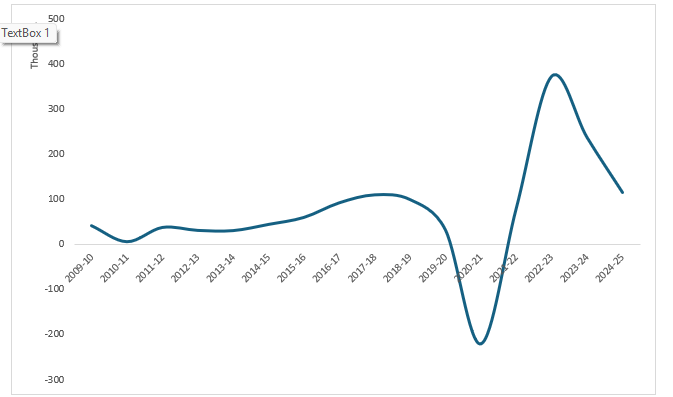
Source: Gamlen, A. and McDonald, P. (2026). Governing Temporariness in a Settlement State: Why Net Migration Targets Fail and What to Do Instead. ANU Migration Hub Insights 26/2. The Australian National University.
Over the past two decades, Australia has changed from a classic settlement state into something more complex. For much of the twentieth century, migration policy was organised around permanent settlement: people arrived, settled, and became part of the long-term population. Today, a large and growing share of migrants arrive on temporary visas: international students, working holiday makers, temporary skilled workers, and others whose status is conditional and whose pathways to permanence are often uncertain.
These temporary residents are deeply embedded in Australian society. They work, rent housing, use infrastructure, and shape labour markets. But they are governed through a policy debate that still revolves around annual NOM figures.
That is a category error. NOM is not a policy lever. It is an accounting outcome. It adds together very different kinds of movement: permanent migration, temporary migration, and the movements of Australian and New Zealand citizens. Those flows are driven by different rules, institutions, incentives, and external shocks. As a result, NOM is too blunt an instrument to govern the thing that most concerns policymakers and the public: the scale of temporariness.
A simple stock–flow model makes this clear. Australia’s population can be thought of as two stocks: a permanent population and a temporary population. The temporary population changes in only two basic ways: through net temporary inflows, and through transitions from temporary to permanent status. If temporary inflows exceed conversions to permanent residence, the temporary population grows. If conversions match inflows, it stabilises.
Figure 2: Simple Model of Population Growth
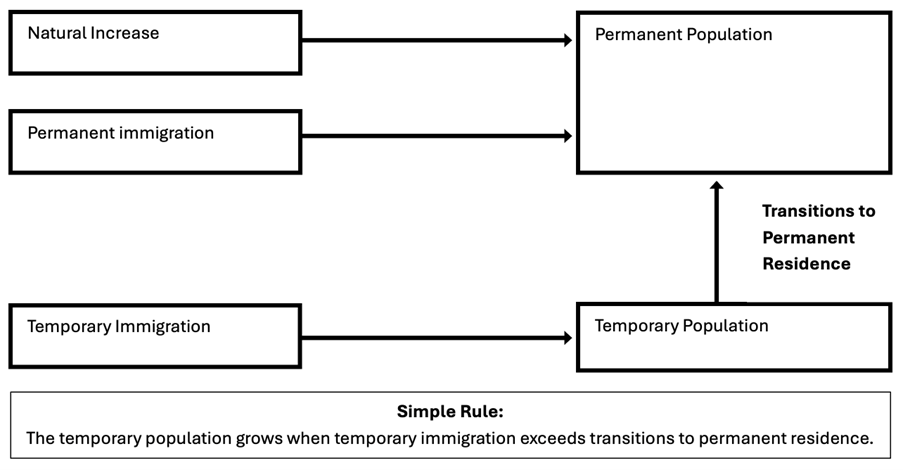
That is the key demographic rule. This means that the size of the temporary population is governed not by NOM as such, but by the relationship between temporary net migration and transitions to permanence. A government could hit a NOM target while the temporary population continues to expand. Equally, the temporary population could shrink even in a year of relatively high NOM, if enough people move from temporary to permanent status.
Recent Australian experience illustrates the point. The post-COVID surge in temporary migration is often described as if it were simply a story of “too many arrivals.” But that is only part of the picture. What actually happened was more structural. During the pandemic, many temporary residents stayed longer than expected because departures were disrupted. When borders reopened, new arrivals were added on top of an existing cohort whose exits had been delayed. At the same time, transitions to permanent residence remained comparatively stable. The result was a widening gap between temporary inflows and conversions, and therefore a sharp increase in the temporary population.
Figure 3: Migrant Arrivals and Departures
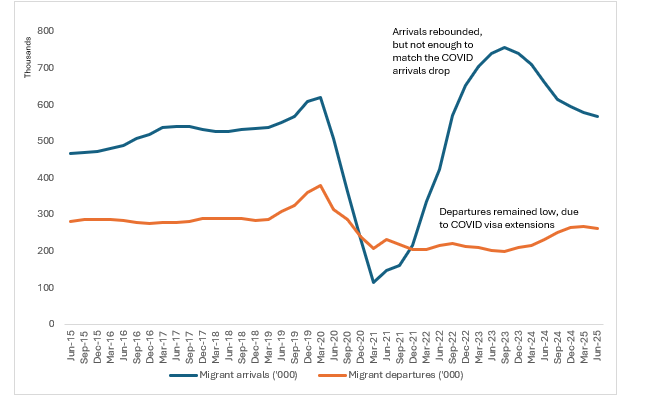
In other words, the recent “bulge” in temporary migration was not just a flow problem. It was a stock problem.
This is why annual NOM targets are such poor tools for governing migration in a settlement state. They manage a residual number rather than the mechanism that drives population change.
Canada has recently moved closer to recognising this reality. Its latest Immigration Levels Plan includes an explicit target to reduce the temporary resident population from 7.6% of the population to 5%by 2027. That is an important shift from flows to stocks. But even there, the chosen benchmark appears to be a policy judgement rather than the product of a transparent demographic rule.
Australia can do better. Instead of targeting NOM, migration policy should be anchored to settlement capacity. The simplest way to do that is to align temporary net inflows with the number of temporary residents who are permitted to transition to permanent residence each year. If conversions broadly match inflows, the temporary population will stabilise. If government wants the temporary population to shrink, conversions must exceed inflows for a time.
This conversion-anchored approach would not solve every migration dilemma. It would involve real trade-offs. It could reduce short-run labour market flexibility and increase pressure on the permanent migration program. But it would at least align policy with demographic reality.
Most importantly, it would reframe the migration debate around the right question. The issue is not what NOM number to choose each year. It is how much temporariness a settlement state is willing — and able — to sustain.
Australia needs a migration debate that reflects the system it actually has, not the one it once imagined. That means shifting attention away from headline net migration figures and toward the size, dynamics, and governance of the temporary population itself.
If temporariness has become structural, then it must be governed structurally.