On 27 January 2026, the Spanish government announced a mass regularisation programme expected to grant legal status to around 500,000 irregular migrants. This week, the measure was approved by the Council of Ministers and entered into force upon its publication in the Official State Gazette (15 April).
The policy comes amid heightened debate on migration and integration and follows a citizen-led initiative that gathered more than 700,000 signatures. By adopting the programme through a Royal Decree, the government avoided parliamentary bargaining, allowing it to move forward quickly.
While the programme forms part of a longer European pattern in which governments have periodically used ad hoc regularisation to address irregularity, it comes at a time when most are tightening admission and integration policies. Against this backdrop, what does the decision reveal about the evolving role of regularisation in migration governance, and what will its design mean in practice?
Who qualifies and what the programme offers
The programme covers foreign nationals in an irregular situation in Spain who can demonstrate continuous residence before 1 January 2026 and have resided continuously for at least five months. Unlike the 2005 normalisation programme - Spain’s largest comparable policy tied closely to labour market participation - the 2026 programme adopts a broader set of criteria, combining residence requirements with additional conditions relating to employment, family ties, or vulnerability.
While formally nationality-neutral, the programme is likely to reflect the composition of Spain’s foreign population. According to recent data from Spain’s National Institute of Statistics (INE), Morocco remains the largest foreign nationality, followed by Colombia and Romania. However, recent growth has been driven mainly by Latin American nationals, particularly from Peru, Colombia and Venezuela (Figure 1).
Figure 1: Foreign population in Spain, 2025
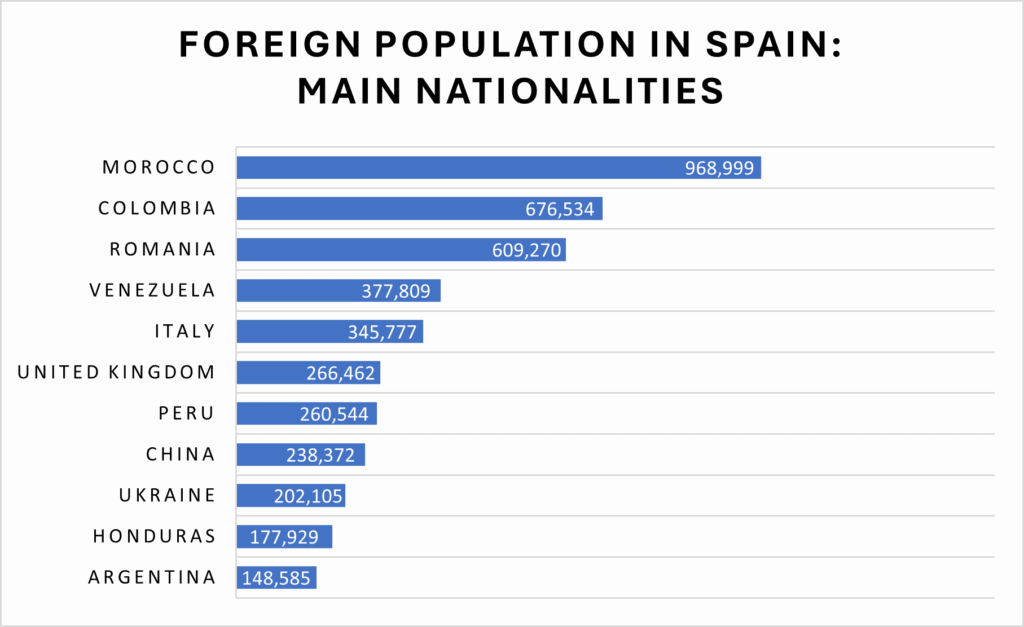
Foreign population in Spain, 2025 (graph)
Source: INE, Annual Population Census - 2025.
The programme is likely to have a particular impact on Latin American communities, whose linguistic and historical ties with Spain have often facilitated labour market incorporation but not access to legal status. Existing research suggests that regularisation consolidates existing labour market participation rather than creating new forms of inclusion.
Eligibility also extends to asylum applicants, including those with pending or rejected claims. In contexts of prolonged uncertainty, regularisation may offer a faster route to legal residence, operating as an alternative administrative pathway alongside the asylum system. While this may provide quicker access to legal status for some, it also raises questions about how administrative pathways are displacing rights-based protection.
This matters most where backlogs or high rejection rates persist, as regularisation can ease pressure on asylum systems while reshaping how legal status is granted. Whether this ultimately strengthens protection or reshapes the role of asylum will depend on how both systems are designed and coordinated in practice.
If approved, applicants receive a one-year residence and work permit, with access to formal employment and to the social rights associated with legal residence, enabling those on the programme to move from administrative invisibility into recognised participation in the labour market and welfare system.
Yet the security offered is explicitly time-bound. The permit does not automatically convert into permanent residence, meaning beneficiaries must transition into ordinary immigration categories under existing rules without any guarantee of renewal. In practice, this requires meeting additional conditions, such as securing formal employment or fulfilling residence requirements. The enjoyment of these rights is therefore temporary, and longer-term stability remains uncertain. Much will depend on whether pathways to more durable residence are not only available, but effectively accessible in terms of costs and requirements.
Where Spain stands compared to the rest of Europe
Spain’s 2026 regularisation programme is not an isolated initiative. Governments across Europe have periodically used ad hoc regularisation to address irregularity, with variations in programme design shaping access.
For example, Italy’s 2020 regularisation, introduced during the COVID-19 pandemic, was limited to sectors such as agriculture and care work to address labour shortages. In practice, access was determined by programme requirements rather than labour demand, with entry conditioned on employer mediation, strict documentation, and employment in specific sectors.
These conditions significantly limited who could apply. Workers outside the specified sectors, those unable to secure employer sponsorship, or those lacking formal documentation remained excluded. Despite the presence of a much larger irregular migrant population, only a limited share ultimately regularised their status. The Italian case illustrates a broader point: regularisation is not inherently expansive or inclusive. Its impact is shaped by procedural and eligibility requirements.
By contrast, Ireland’s 2022 “Regularisation of long-term undocumented migrants” programme adopted a different design logic. Rather than linking eligibility to labour shortages, specific occupations, or employer sponsorship, the programme centred on length of residence. It was open to migrants regardless of nationality or occupation, reflecting a residence-based approach to granting legal status.
These cases highlight a broader point: regularisation in Europe has not worked as a single policy instrument, but as a flexible governance tool whose outcomes depend on how it is designed. Eligibility criteria, duration of permits, requirements, access to rights, and the availability of pathways to longer-term residence shape what programmes deliver.
An uncertain future
Spain’s 2026 programme, designed as a one-off measure, addresses prolonged irregularity but does not in itself resolve the instability built into temporary legal status. Its long-term significance will depend less on the initial grant of residence and more on whether beneficiaries can move into durable legal categories. Without that, the programme may reduce irregularity in the short term but continue to reproduce uncertainty over time.