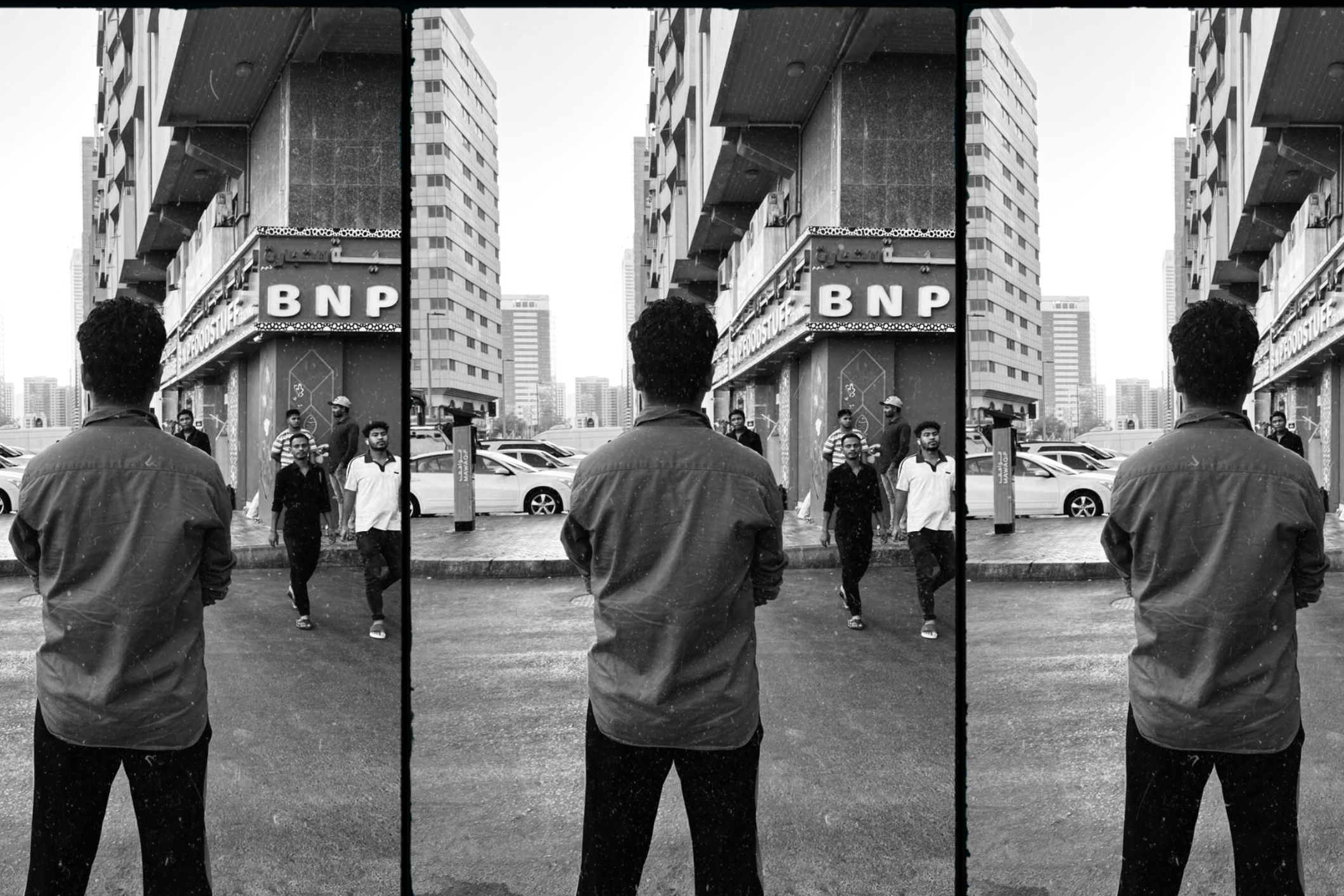
“I had to do housework and manage everything alone. That felt different from what I used to believe,” shared a 26-year-old returnee migrant from Feni, in South Eastern Bangladesh. When he left his village for Dubai, the idea of what made a ‘good man’ included being the breadwinner and fulfilling his familial responsibilities towards his parents and family members, certainly never doing household chores like cooking or washing clothes.
However, in an overcrowded labour camp on Dubai’s outskirts, far from his mother’s kitchen and his father’s expectations, this young man found himself boiling rice, scrubbing dishes, folding laundry, and cleaning toilets. He called these ‘women’s jobs’ and commented on how tasks often made him feel like he was emasculated. “It made me question if these tasks define manhood”, he said quietly.
His story reflects a hidden truth for many Bangladeshi male migrants in the Gulf. The journey to earn and provide, both physically across borders and metaphysically through kinship ties, often challenges senses of manhood. In the glitzy streets of Dubai, behind the towers built by migrant hands, there are daily negotiations of fragile masculinities and silent struggles that scarcely make it into policy debates. A conversation with a group of individuals in Dubai was particularly illuminating. Whilst we were all sipping chai, labour migrants shared concerns about their children disobeying them and being fascinated by goods and commodities sent from abroad. Research suggests that male labour migration often comes at the cost of rising tensions between breadwinning and fathering.
For many men from rural Bangladesh, migrating abroad is often framed as the ultimate proof of being a ‘real man’. To be successful is to build a concrete house, pay for a sister’s wedding, and send your children to school. Recent studies show how deeply masculinity is tied to breadwinning in South Asian communities and how, according to the migrants and their families, the primary goal of migration is often to succeed financially. In many instances, individuals fail to live up to these expectations and experience periodic cut-offs with their families.
Less of a man in a ‘city of men’?
But what happens when reality bites? In Dubai, Bangladeshi migrants live in overcrowded labour camps like Sonapur, described as a ‘city of men’, where thousands sleep in tight dormitories with communal toilets and no family life. With no wives, mothers, or sisters present to do domestic chores, men must encounter collapsing traditional gender roles. Research shows that domestic labour is strongly feminised in Bangladesh, and for many, cooking and cleaning are not just new tasks but rather a threat to notions of masculinity. A man washing his clothes is seen, in some eyes, as ‘less of a man’. Coping strategies can reach an extreme when there is a constant need to try to hold onto a ‘successful image’ back home. A Guardian report stated that during the COVID-19 pandemic, despite many South Asian workers in Dubai starving and feeling abandoned, many of them continued to send money to their families. Likely, they were still under pressure from their families to perform successfully, irrespective of the severity of the pandemic.
For many labour migrants, prolonged isolation stands out as a harsh reality. A recent study on Indian workers in the UAE found that 77% of migrant men working in the UAE felt lonely during the pandemic, which was evident from a young man I spoke with: “I felt isolated in Dubai because I was far from my family. I was mentally down.” Some Bangladeshi migrants shared that they have been away from their family and friends for more than a decade, battling loneliness and a sense of disconnect. Over time, distance frays bonds, children come to know their fathers only through remittances and phone calls; marriages strain under years of absence; community ties gradually fade. To endure this emptiness, migrants adopt a range of coping mechanisms, some constructive, others harmful. Many migrants search for solace in their cramped quarters, while others choose endurance, with only a few who resort to destructive escapes to stoically deny pain.
Migrants’ coping strategies and sacrifices remind us that behind every remittance sent from the UAE lies a personal story of human fragility and unmet expectations. Despite discussion of exploitation and wages, migration policy in Bangladesh largely neglects the hidden costs of the everyday pressures on men to live up to impossible ideals, often coping in silence and suppressing needs such as quality health care and counselling.
Ishret Binte Wahid is a doctoral Student at SOAS.
Ishret Binte Wahid is a PhD candidate in the Department of Development Studies at SOAS University of London. Her doctoral research focuses on the transnational flows of social remittances and sexual norms between Bangladesh and the United Arab Emirates, and how these dynamics reshape masculinities among Bangladeshi male labour migrants.