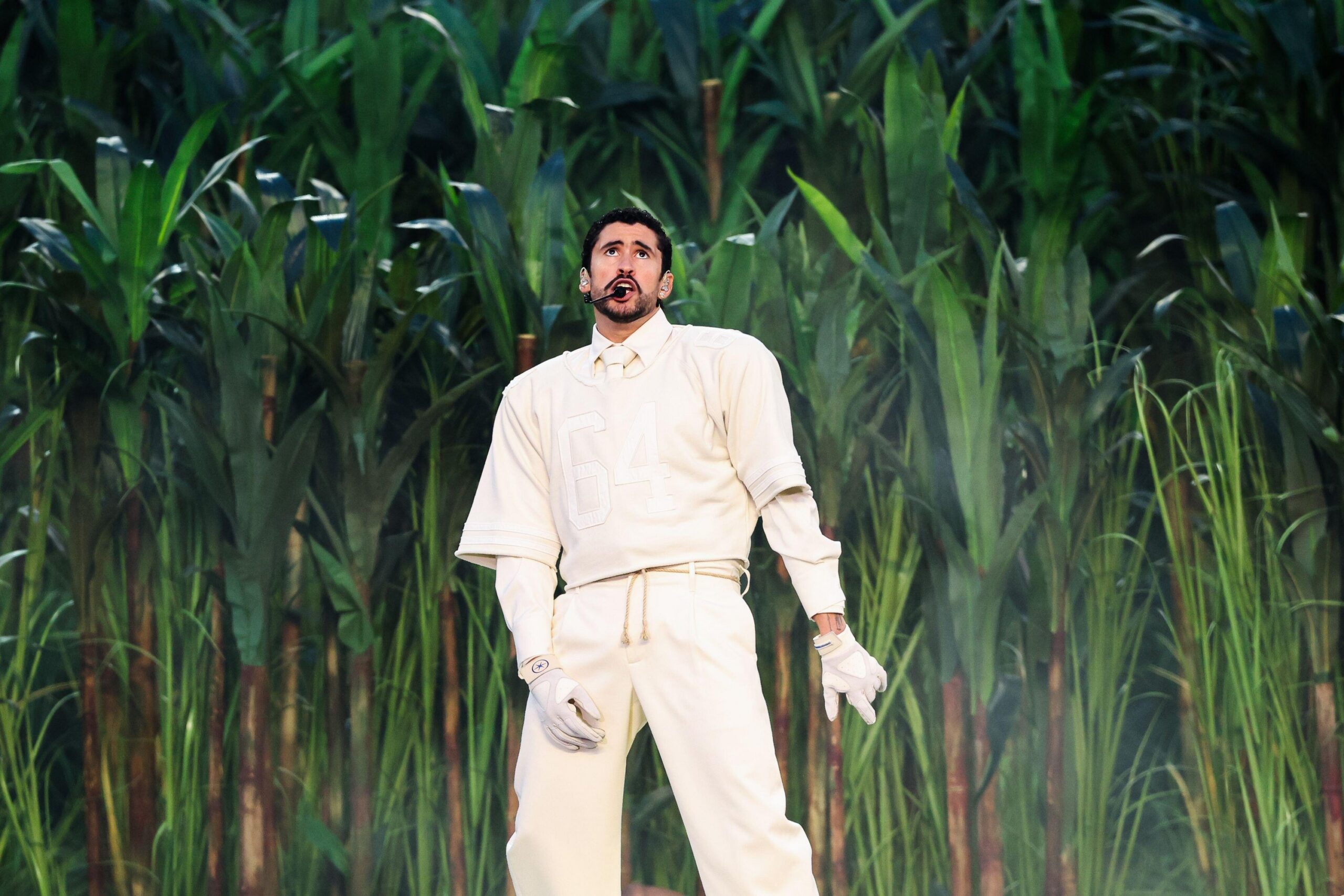
The public response to Puerto Rican musician Bad Bunny’s performance at the Super Bowl halftime show has been expansive and, despite its message of unity, politically divisive.
On one hand, high viewing and streaming figures suggest that it was hugely popular with audiences across the United States and globally. On the other hand, the performance was met with swift rebuke from activists and commentators on the political right in the US, starting with President Trump and then diffusing onward through aligned voices across conservative media and social platforms.
At first glance, this backlash may seem puzzling. The performance itself did not explicitly criticise the president or directly engage with partisan political issues. Rather, it celebrated Puerto Rican and Latin American culture, incorporating visual and musical references to heritage, language, and identity. The presentation did include elements of social commentary, but these were directed primarily at Puerto Rico’s enduring infrastructure challenges, including its recurring and widely-documented electricity blackouts.
The question is, then, why the performance generated such a strong response among some on the right of US politics?
Music as an Instrument of Change
The answer arguably lies in a point of commonality between incumbent political powers in the US and Bad Bunny; both recognise the power of popular music as tool to challenge, reform, and even revolutionise the political status quo. For those who currently hold power in the US, therefore, popular music – including the groove of Bad Bunny – can represent a potential threat.
Music and song convey ideas and information through lyrics and performative symbolism. They also evoke emotional responses through melody, harmony, and rhythm. Crucially, music is consumed within a social context – whether in stadiums, living rooms, or online communities – creating shared experiences that can amplify meaning. Together, these characteristics of popular music can contribute to social and political change through three interrelated mechanisms: reimagining, discourse, and mobilisation.
First, songs and musical performances can inspire a reimagination of the current social and political order by suggesting that alternate realities are possible. John Lennon’s “Imagine” is the classic example, inviting listeners to envision a world without social structures and material desires. A world that unites rather than divides.
In his halftime show, Bad Bunny engaged in a similar act of reimagining. He challenged dominant narratives about what “America” looks and sounds like. He provided a vision of America as a continent rather than a single nation, with multiple cultures and languages. He also situated his native Puerto Rico, which has a colonial type of relationship with the United States, at the centre of that multi-nation vision of America.
There is a subtle radicalism in reimagination. It does not need to shout, just to reframe. It does not always confront power directly, but unsettles the assumptions that sustain it. Without delivering a partisan speech, Bad Bunny’s performance invited viewers to reconsider who counts, whose language resonates, and whose histories shape the meaning of America. For instance, Spanish was not translated or softened for comfort of the audience. It stood unapologetically at the centre of what is the most-watched broadcast in the United States.
Second, music can foster dialogue and, in so doing, transform reimagined ideas into political issues and platforms. Because the consumption of music is inherently social, it provides a forum for communication, discussion, and debate around a reimagined world; a halftime performance watched by tens or hundreds of millions becomes a catalyst for commentary across news outlets, social media, and private conversations. Thus, ironically, by responding so vocally to Bad Bunny’s performance, critics on the right of US politics amplified and politicized the very themes they sought to contest. Their backlash helped elevate these cultural and political questions into broader public discourse, increasing their salience and translating social concerns into points of political contestation.
Third, music can drive mobilisation in support of political resistance and protest. Songs can frame issues in an accessible and emotionally resonant way that motivates individuals to push for change. Once the public is motivated, music and musicians can facilitate the translation of grievances into action; popular musicians have vast platforms that can be used to promote calls to action, and the promise of musical performances at protests can provide individuals with incentives to turn out – not only to see the artist in question but also to experience a collective sense of moral purpose, solidarity, and even celebration.
Bad Bunny is aware of all this. In 2019, following a leak of offensive Telegram messages by the then-governor of Puerto Rico, Ricardo Rosselló, Bad Bunny collaborated with fellow Puerto Rican musicians, Residente and iLe, to produce a song that framed public grievances by bluntly denouncing Rosselló. Ricky Martin then joined public calls for fellow Puerto Ricans to head to the streets, where all the above artists gathered and joined public musical performances. After days of protests, Rosselló resigned.
Music as a Site of Ongoing Resistance
The controversy surrounding Bad Bunny’s performance reveals something larger than a disagreement about a single show. It underscores the enduring potential of music to act as a political tool. History offers ample precedent. In recent weeks, Bruce Springsteen wrote and released a song directly challenging the presence and actions of ICE in Minneapolis. The administration’s reaction to the Springsteen song, and the furore that has followed Bad Bunny’s Superbowl show, suggests that the power of music is neither forgotten nor dismissed. On the contrary, it is taken very seriously; the age of music as a force in political life is far from over.